PREMA JYOTHI - Newsletter of the Prema Trust and Sacred Earth Community – July 2026
“One has to develop three P’s to safeguard one’s humanness: Purity, Patience, and Perseverance. These are the three essential human values. When you have purity, you will attain sathya and dharma and experience bliss by practising them. When you have
patience, you will have righteous conduct and observe nonviolence. When you have perseverance, you will attain all the human values.” - Sathya Sai
Kia Ora Whanau
In a world that is fast losing its humanity, with lives that are getting faster and faster, the virtue of patience is becoming a rare commodity. In societies that require instant gratification, the virtue of perseverance is being valued less and less. Where desire roams freely, and corruption has infiltrated every stratum of society, purity is being regarded as old-fashioned. Yet, as Sai tells us, the acquisition of these three virtues is one of the core foundations for living a spiritual life. In this moths newsletter, we will explore some of important aspects of the three virtues – patience, perseverance and purity.
Patience is a virtue, possess it if you can
This beginning line of an old poem that my mother used to quote to me often when I was a child, shows that patience was valued in times gone by. Nowadays, we want everything at speed. If we text someone, we expect a text back almost immediately and get cross if this does not happen. If we are in a car and waiting at traffic lights, we get annoyed if they are slow (or even just changing at their normal speed). As we came up the Himalayas on the narrow mountain roads, we often strike two buses trying to pass each other. It is a dance that some drivers do well whilst others simply will not give way. It is a great test of patience. In fact, India itself is a good place to learn patience as things do not always progress quickly!
How do we develop patience?
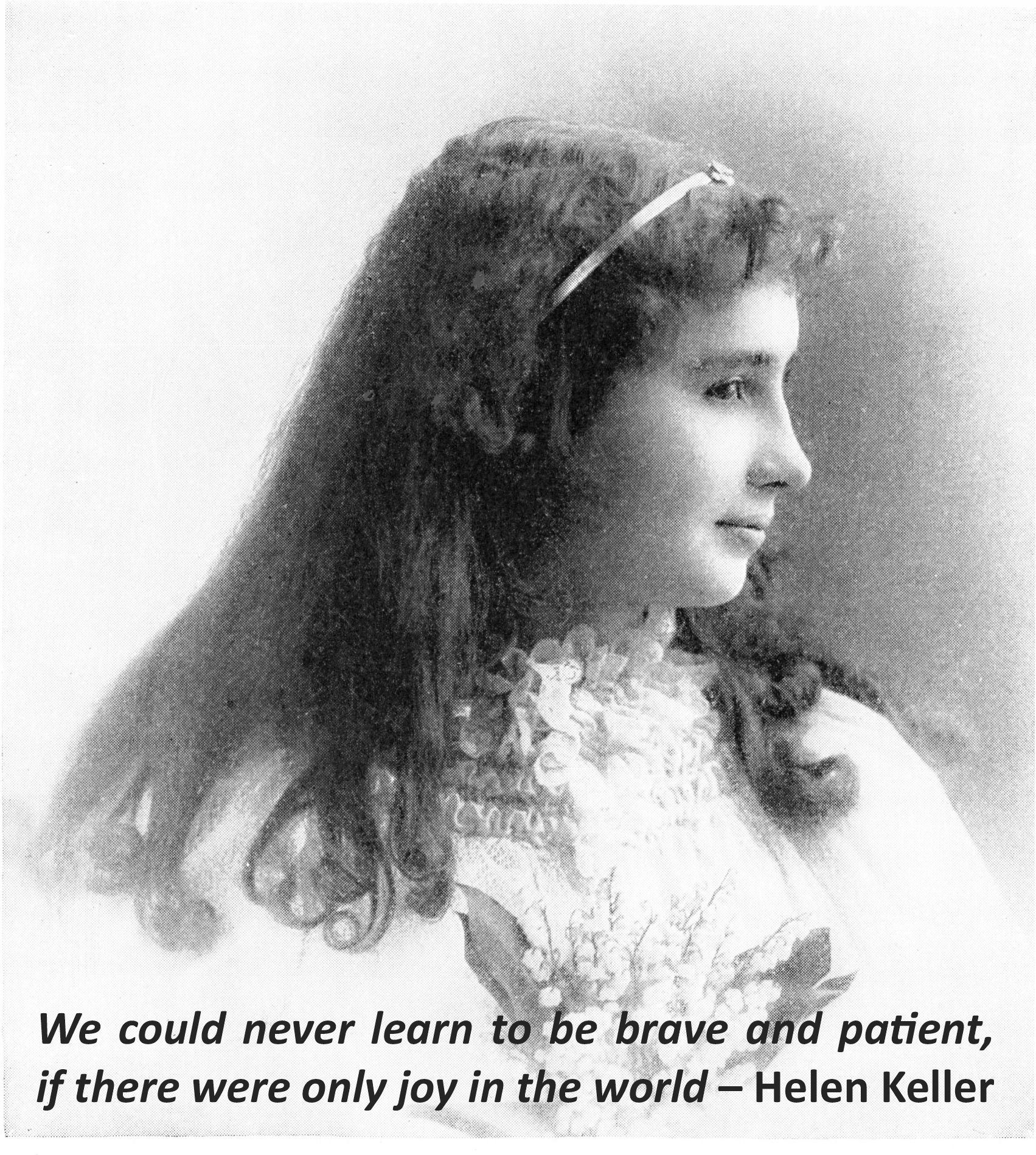
The most effective way to develop patience is undertake challenging activities. The story of Helen Keller is illustrative of the role of challenge in developing patience, perseverance and purity. We do not develop patience and perseverance in a cozy environment. Keller certainly had challenges. At the age of 19 months, she contracted an illness which left her blind and deaf. Unable to communicate, she became an unruly child. Her parents contracted a gifted teacher, Anne Sullivan, who was also visually impaired. Anne began to teach Helen through touch. This was a long, slow process, but Helen succeeded in learning and developed the ability to speak. Her life is a story of patience and perseverance. Her achievements are awe inspiring. She gained a degree and went on be active in society, working for labour rights, civil liberties, women’s rights and pacifism.
We need to be taken out of our desire for instant gratification. For those who step forward into the spiritual path, challenges occur at the beginning and patience is tested. This seems to be the gateway into spiritual practice, essential to the nature of the path. When I first went to Sai Baba’s ashram – Prasanthi Nilayam, we would wait for hours to see Him, mostly in the hot sun. It was a true test of our resolve to have his darshan (seeing a holy person or place). All of us had to learn patience and to find a place inside where we were content to wait. Patience is a virtue that we develop through trials and tribulations.
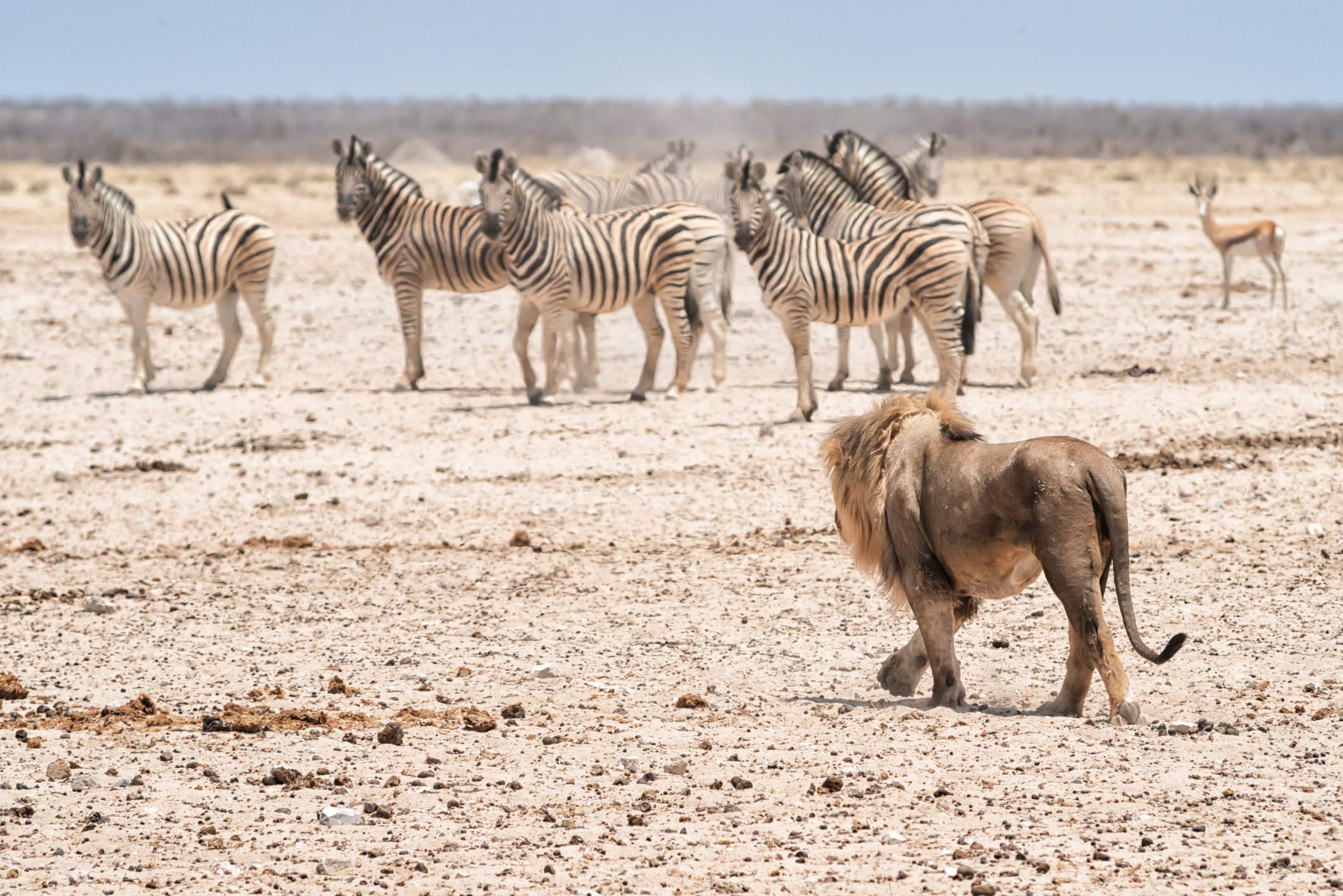
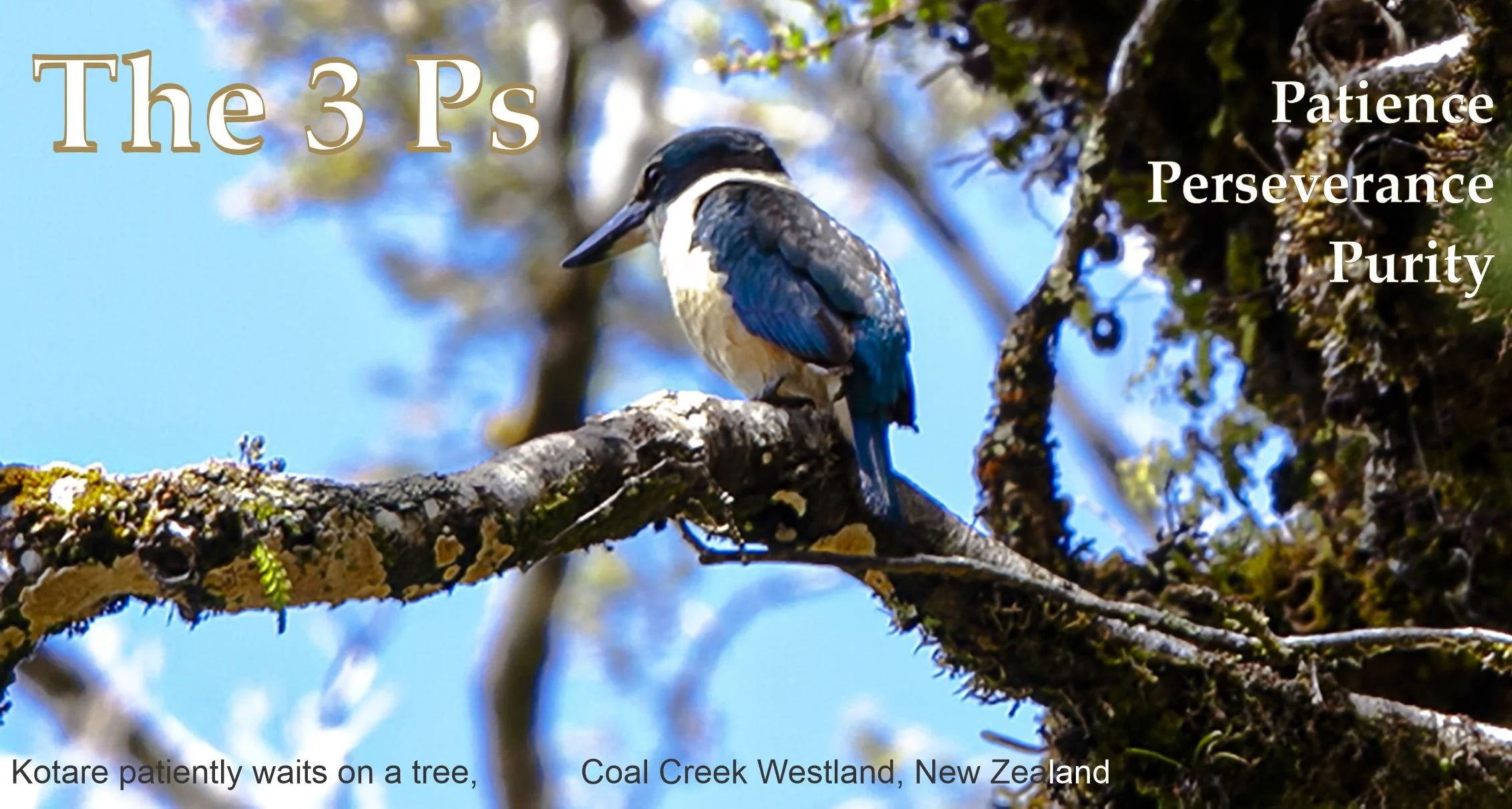
Consider a hunting lion. It does not rush madly at its prey. It stalks quietly and stealthily until it finds the perfect moment to strike. It is extraordinarily patient. Birds, like the Kotare in the heading picture of this newsletter can wait for hours before collecting food. In taking this picture, I also had to wait a long time. I had seen the Kotare enter its mud nest and knew it had to come out again. (It is the nature of these birds to sit for some time before flying off.) I waited half an hour to take this picture of the Kingfisher. (Photographers are known for their patience.)
In spiritual life we mostly progress slowly. It is an unusual person who finds instant realisation. We develop through stages, and patience is required at each step. The one to whom we must show the greatest patience is ourself! This does not mean we have to sit in meditation for years on end, but rather acquire the necessary attributes and experience through serving others, being kind, tolerant and generous, gradually seeing the One in the many.
Perseverance
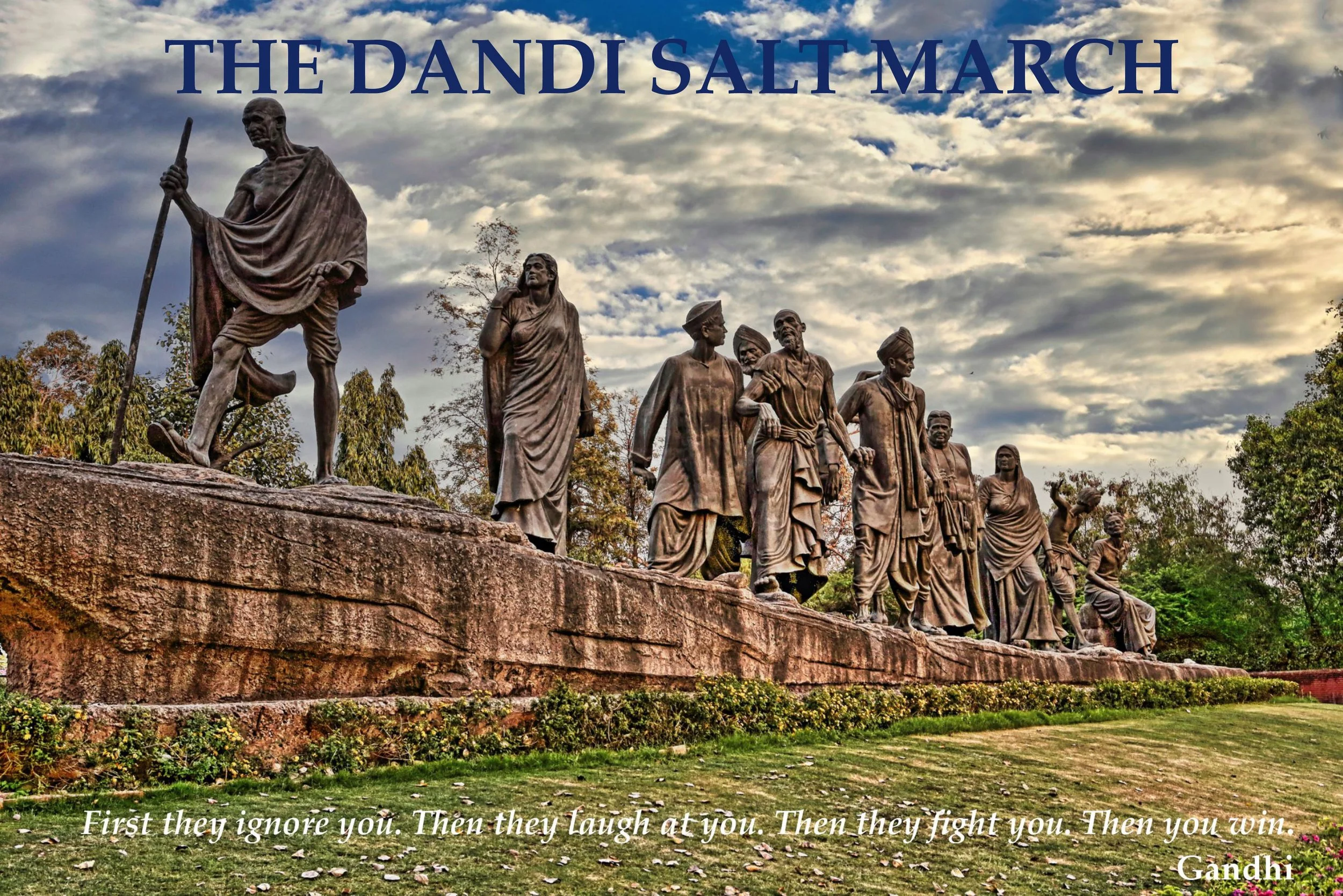
This virtue will take us far in life. It is possessed by all people to some degree, but its full development is a prerequisite for spiritual life. There are many examples of perseverance in history. The one that stands out to me is that of Mohandas Karamchand Gandhi, commonly known as Mahatma Gandhi. One incident among many in the life of Gandhi is termed the Dandi Salt March. In the twenties (check dates) the British, who ruled India at that time, placed a tax on salt. Salt, being a commodity that all people, be they rich or poor use, was now an instrument whereby the British could oppress the Indian population further. Gandhi resolved to rectify this by defying the salt tax order using a very unique strategy. He organised a march from his ashram to the ocean. There he intended to distill salt from seawater, thus circumventing the tax. A small band of marchers set off but were soon joined by more and more, until it became a large crowd. They marched to the beach, collected sea water and by boiling the water off, collected salt, for which they would not pay the tax. The British, at first furious, later rescinded the salt tax. This is a great example of Gandhi’s perseverance. He campaigned for years and years, first in South Africa and then in India for Indian independence. That this independence came at a great cost was not his wish. He never relented, but struggled on and on, landing him in jail several times and, ultimately led to his death.
How Do We Develop Perseverance?
Anything worth doing requires some dedication, grit. If we have a resolve or an intention, we can only achieve this through persistence and hard work. How might we acquire such fortitude? It is foolish to think that we can simply persevere without some form of graduated development of this virtue. Children who are molly-coddled will struggle. Children who are harshly treated will be too damaged to be able to develop persistence. There is a middle ground where children are encouraged to explore their limits in a safe environment and to not give up easily, whilst being acknowledged for their achievements, even small ones.
As adults we are faced with many challenges. We often get bruised by the world. We often want to run away from situations. Many marriages result in splits. For some the split is positive and required. For others it is often the easy way out. I speak from the point of view of one who’s marriage has faced many difficulties, external and internal. I can attest that, if it aligns with dharma to persist, there is a great reward of freedom within the bonds of friendship.
One other illustration from my life that I am happy to share. Every year Savitri and I take a trek up to Tapovan, fourteen and half thousand feet up in the Himalayas. This journey of two days (from Gangotri at the headwaters of Ganga) takes us from 11,000ft up to the height of Tapovan. Inevitably I struggle on this trek. When altitude hits me, I am suddenly weak, often dizzy and occasionally nauseous. I slow down dramatically.
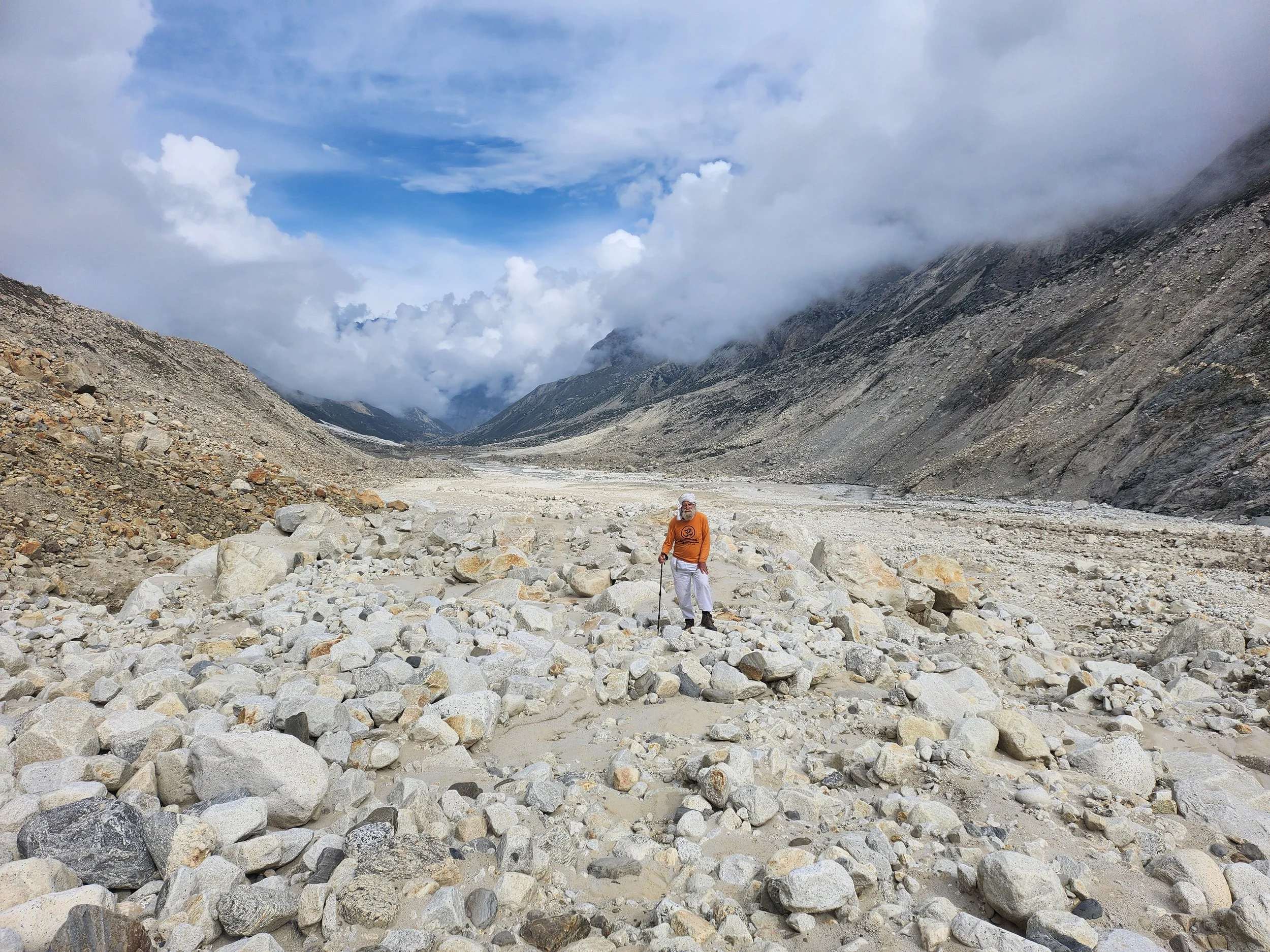
Savitri on her way to Tapovan
I find I come into a space where I am simply putting one foot in front of the other. On occasion, the guide says that I should go back down. But I know that I will get there. There is a deep knowing somehow, beyond logic. I keep going, taking the journey in short phases – “I will get to that rock, or that tree, or that corner of the trail.” The last part is the hardest as we ascend a steep escarpment to find ourselves in the beautiful aura of this sacred place. What is it that keeps me going. First, it is intention. We go up to Tapovan for spiritual sadhana. Secondly, I feel that the greatest obstacle is myself – the mind that says ‘you can’t do it’ and I find myself detaching from that thought.
Thirdly, and probably most importantly, it is sheer bloody-mindedness. “I will get there. This will not defeat me” So every time I reach Tapovan and bathe in the spiritual essence of the mountain Shivaling, and rejoice in the beauty of Mother Nature that is to be found there. This along with coming into the stillness that pervades the sacred landscape. Without persistence, this experience would not be possible.
Purity is Our Very Own Nature
Often times purity is a loaded word. We think of pure people as those who have no stain on their character, who are with out errors or mistakes. Whilst this is a beautiful concept, there is a possibility that it is also a false impression of what it means to be pure. Purity can be thought of as a result of patience and perseverance. There is some value in coming to an understanding of how this might be.
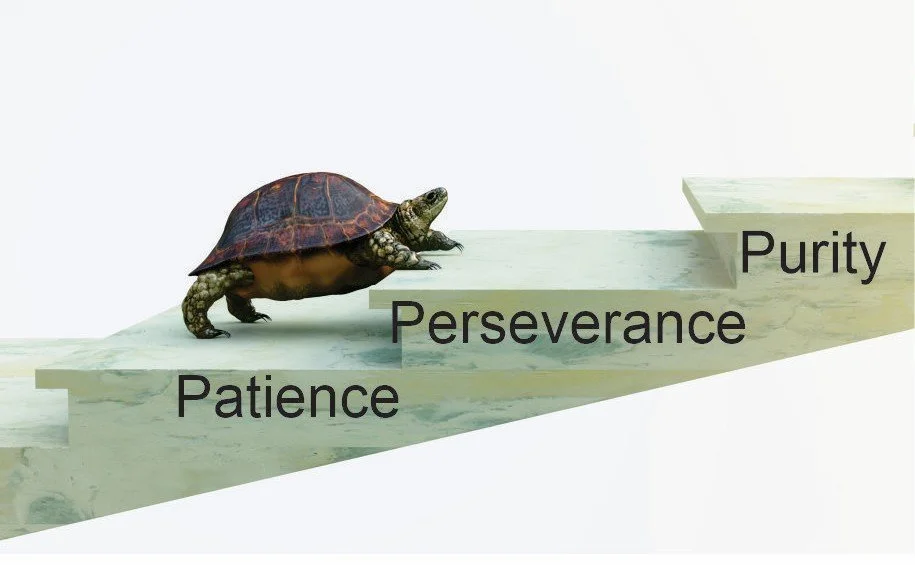
Like the tortoise in the picture, we slowly make our way up the staircase of life. We have seen that patience leads to, and is a vital component of, perseverance. The hunting lion is patient. Gandhi had great patience, enduring jail sentences with calmness and understanding. He was even greatly forgiving towards his captors. It appears that enduring life’s ups and downs leads to a falling away of the tendency to grasp at the world, and fosters surrender to what is. When we are patient, we begin to lose our need for things to happen the way we want them to happen. When we fix an intention and persevere in its manifestation, if it is for the good of not only ourselves but the world at large, we begin to shed the tendencies that keep us bound. Purity can be thought of as the absence of impurity. But that is only a superficial understanding. Purity arises when the mind is focused on a single purpose. It is then that we move into a space where there is no distraction. Our intention, our thought, becomes pure. In that moment, a everything else falls away and the pure will of our own divine nature manifests. When we patiently move towards that place, with determination and perseverance, purity arises automatically. Then the inner light reveals itself in its pristine nature.