PREMA JYOTHI - Newsletter of the Prema Trust and Sacred Earth Community – May 2026
Kia Ora Whanau
Turning to the topic of renunciation this month, it is probably important to address some of the misconceptions around the concept of renunciation, whilst defining what true renunciation is and the outlining the arenas where renunciation can be practised.
January’s newsletter presented aspects of attachment and detachment. Last months (April’s) newsletter looked at the phenomenon of impermanence. Renunciation builds upon those two important foci of our sadhana (spiritual practice) and describes how renunciation is the process of translating the idea of detachment and the knowing that all is impermanent into our daily lives.
Renunciation is not giving up. Renunciation is not leaving the world and secreting ourselves away in a cave or a monastery. Renunciation is an ongoing process that allows us to distance ourselves from our mental urges and desires, in a very practical sense, whilst engaging with life, with the world. Sathya Sai states:
“Renunciation or detachment (vairagya), of course, does not mean the giving up of hearth and home, or of high estate and even kingdoms. It is the understanding of the divinity immanent in everything, the fading away of all the distinct names and forms, the bliss of experiencing in everything and every place the Divine, which is its reality. That is the true meaning of the maxim “detachment (raga-lessness)”. As long as one cognizes the world of name and form, one is burdened with attachment. How can one be desireless when the mind is immersed in thoughts, feelings, and experience of the objective world? One might have given up all and yet be full of these.”
Inner Renunciation
As we go through life, we are confronted with outer challenges, which then trigger inner feelings and thoughts. Our inner world is deeply affected by the outer world. How do we begin to rectify this acute sensitivity to the happenings on the outer. Think of an ocean. On the surface there are waves crashing and leaping in the world’s wind. The surface of the ocean is affected by wind and weather. But deep underwater the effects that batter the surface are absent. There is a greater stillness. Our lives are much the same. The outer influences direct us to respond, sometimes dramatically, sometimes in more subtle manners. We can become victims to the ways of the outer influences. These days where our phones constantly bring the happenings of the world to our consciousness, this affecting is all the more amplified. We are like the waves on the surface of the ocean, subject to the many influences of the outer. In the world of phone communication there is now the phenomenon called ‘influencer’ where people gather followers and begin to promote products (for which they are financially rewarded). Can this be healthy to have others influencing us in such a direct and available manner? Throughout human history there have always been people who propagandise. That is an age-old phenomenon. Only now, it is so direct and so pervasive. Young people, whose minds are developing and forming what will become tendencies and opinions about life, are particularly vulnerable to such influences.
Life is an ever-changing progression from birth to death
How do we detach ourselves from the programming that often rules our lives? As Sai states, “How can one be desireless when the mind is immersed in thoughts, feelings, and experience of the objective world?” Renunciation often begins with consciousness as to our own attachments, tendencies and inclinations. All these are driven by desire. Often our desires are unconscious – we are not really aware of them, we simply follow the conditioning of the mind.
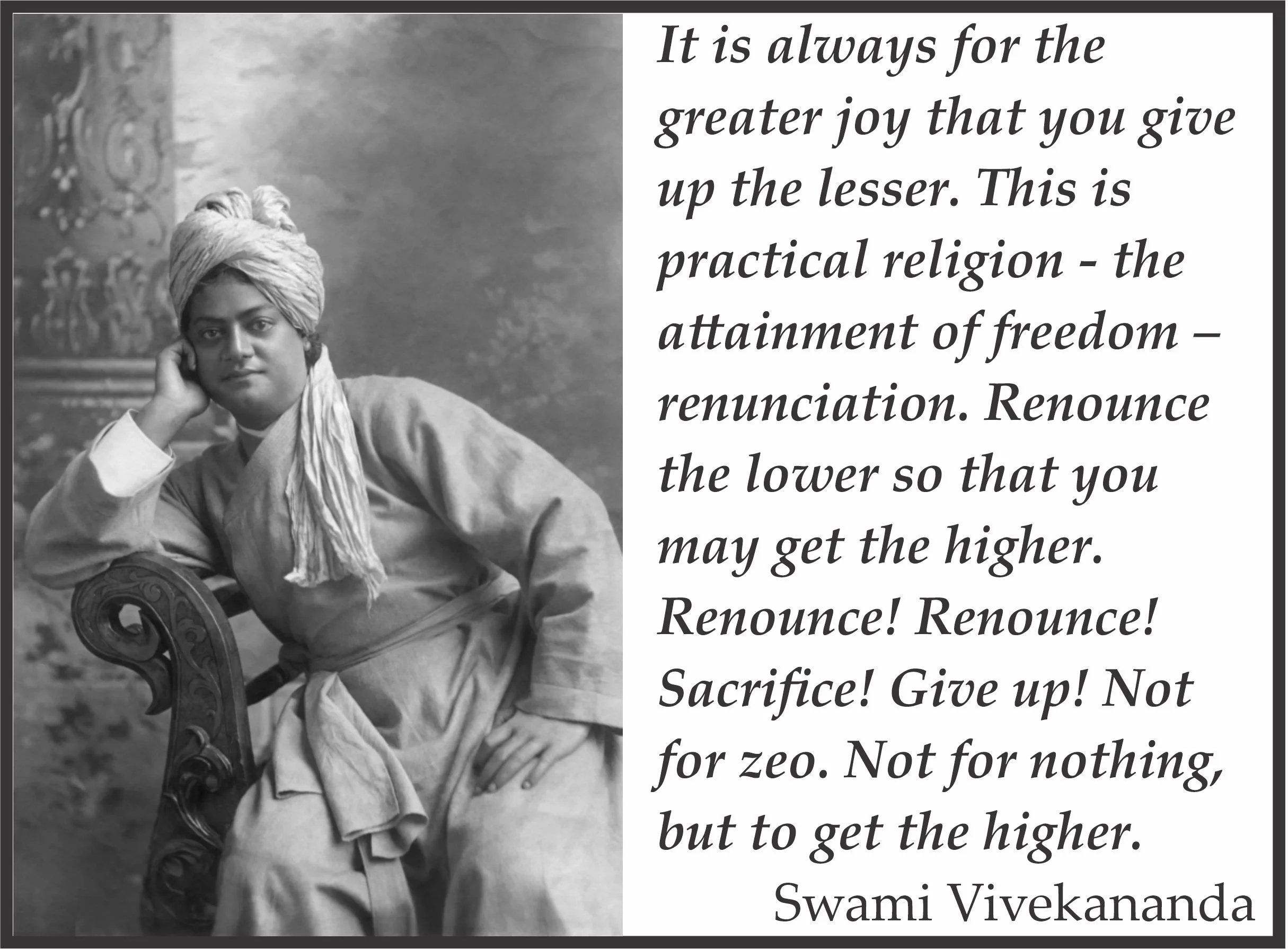
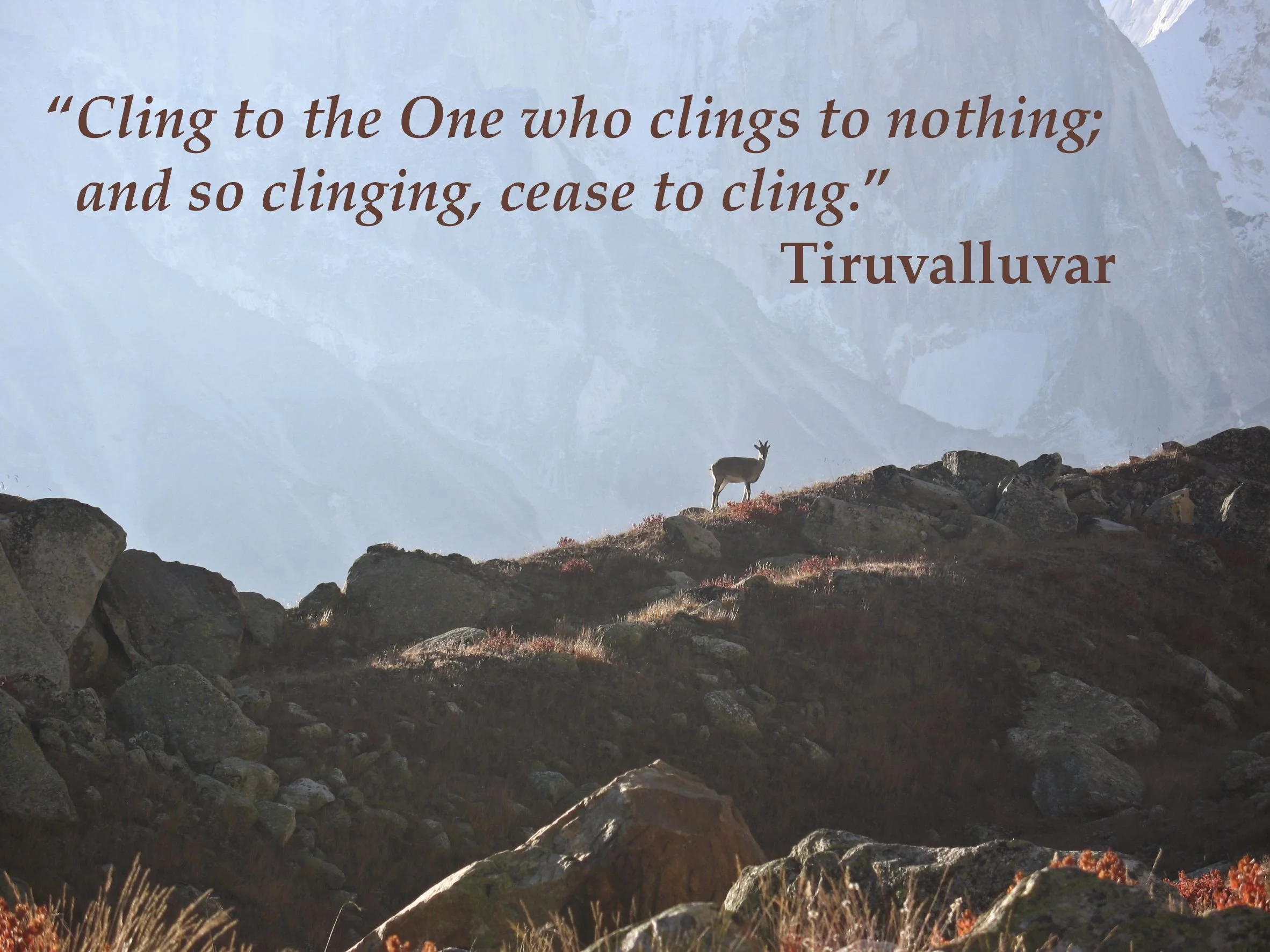
So how to begin the process of renunciation? Detaching from our impulses and desires is a step-by-step journey. It begins with simply practising witnessing. What is meant by that and how is this actually conducted? Many begin with the breath. Sitting in stillness and observing the breath is a universal practice across traditions – Yogic, Buddhist, Christian and Sufi traditions all utilise this method. As we observe our breath, we also become observers of the thoughts that arise. Slowing and regulating the breath begins to slow the stream of thought. Then we are more able to see the thought arising and falling. Sai states that the mind is a bundle of thought, and most (if not all) of those arise from desire. In this process, what are we renouncing? The quote given above puts that process into an elegant simplicity. The One who clings to nothing is the very Self. The foundation of our existence.
We mostly identify with our thoughts. Identification with the body comes through thought. If we can realise that we are observing our thoughts, we can begin to ask the question, ‘Who is the one who is observing?’ This takes us deeper into letting go of our identifications, our fixations with the physical, mental and emotional. Being in a state of disidentification, is renunciation. We renounce the one that we thought we were to become the one that we really are.
The great Advaitic (path of unity) masters usually began their journey with this witnessing, this detached approach. But this stance is not just the domain of advaita. The great devotees of God also become more and more detached from the world.
Consider the great devotee of Krishna, Mirabai. At four years of age, observing a sadhu holding a statue of Lord Krishna close. Seeing the yearning in the small child, the saint gifted her the statue. Seeing other women in the court where she grew up getting married, she asked her mother, “Where is my husband?” Her mother pointed to the statue of Krishna and said to the girl, “Your husband is there.” (It is often stated that she did this to stop the young child’s incessant questions, a common attitude among some adults.)
From then on Mirabai became totally obsessed and devoted to Krishna, who became her friend, lover and husband – no longer simply a mere stone idol. Her one-pointed devotion meant that she had no time for the pleasures of the world. When a teenager, she was forced into marriage. However, her husband was so frustrated with her obsession with Krishna that he treated her badly. Meera did not mind, as she had Gopala (Krishna) in her heart always. Fear and anger could not penetrate the love between her and the Lord.
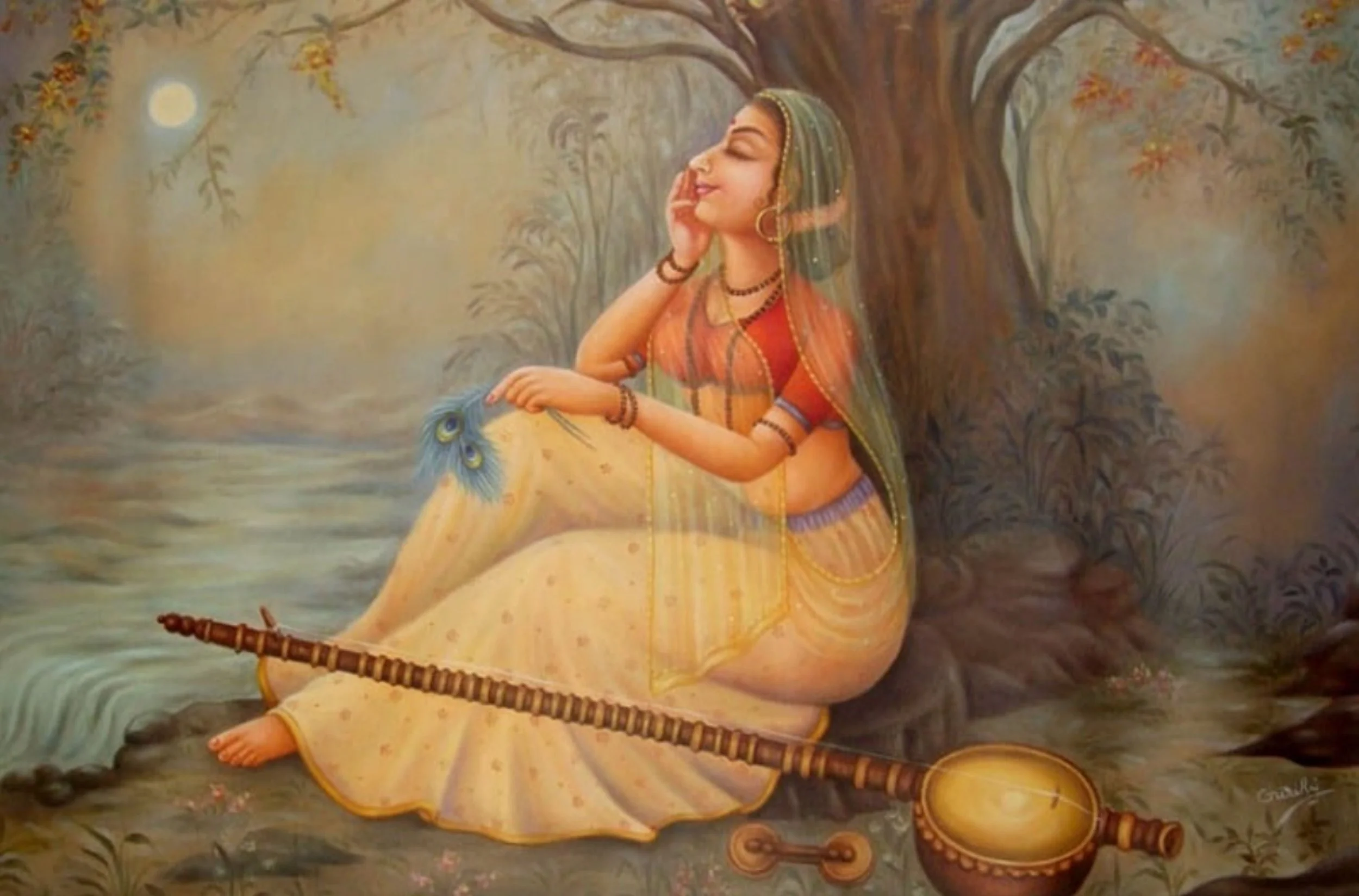
From that devotion was born a deep knowledge of the omnipresence of God. When her family took her on a pilgrimage to a shrine, she stated, “If God is everywhere, why must we come all this way to worship Him?” Meera is often thought a great dvaitin (dualist), but deep within, she was an adviatin (non-dualist). She was able to distinguish between the concept of Krishna being separate (dualism) and the consciousness of Krishna in the Heart as One (non-dualism). She left her marriage and began to wander the plains of northern India until she cam to Vrindavan, the town most associated with Krishna’s young life. There she settled and spent her days in communion with her Lord.
From Mirabai’s heart arose renunciation. It wasn’t a thought in the mind, but an imperative coming from the depths of her being. It was not a decision, but a calling. We can put on monk’s robes and go wandering. But what is that which has caused this renunciation? Is such an action even necessary. Sai tells us:
The Isavasya Upanishad reveals that when you perform actions without ego and when you experience the world without attachment, no distinction remains between pleasure and renunciation. Work without ego and attachment is selfless work - a pleasurable sacrifice. All selfless work is nothing but delightful renunciation. - Sathya Sai
True renunciation arises from a heart that has begun to realise that we are so much more that a body with a bundle of desires and thoughts. We do not have to leave our work or our families. We can function in the world, outwardly appearing no different from others, whilst being freer of desires by living within the Heart.
In the wonderful book Sandeha Nivirani (dissolving doubts) Sai Baba poses questions (as if he is a sadhaka seeking answers) and answers those questions from the Divine perspective. One such series of questions is enlightening and is reproduced here.
“Q. What does physical renunciation mean?
A. Renunciation in appearance, as far as the outer body is concerned. One wears the ochre robe, assumes the name, appears in the form, but has no awareness of the Atma; one wanders amidst all the objective desires clinging to external things. One is like an ordinary person, for all intents and purposes.
Q. And mental renunciation?
A. In mental renunciation, one gives up all decisions and desires; one has the mind under strict control; one is not guided by impulses or agitations; one is ever calm and collected.
Q. You mentioned Atmic renunciation as the third.
A. Here, one breaks through all thoughts about things that are unrelated to the Atma, because one is ever immersed in contemplation of the true reality, “I am Brahman (Aham Brahmasmi).” One is steady in the consciousness of being Atma. One’s bliss (ananda) is continuous. This is called bliss-filled.
We undertake this journey of renunciation from the physical to the Atmic level. We begin to shed our identification with the five koshas or sheaths: annamayakosha (physical sheath), pranamayakosha (energetic lifeforce sheath), manomayakosha (mental sheath), vijnanamayakosha (intelligence or higher mental sheath) and anandamayakosha (bliss sheath).
In meditation we can enter ecstatic states. These often fool us into thinking we have reached moksha or liberation. However, Sai tells us that these states are also temporary, they are not permanent. In the end we have to go beyond even the bliss – the final renunciation. Bliss is an attribute of the One, but it is not the fullness of the One Consciousness. The person who sees the One in the manifold creation has truly renounced. What have they renounced? – the consciousness of separation. What is the product of such renunciation? The consciousness of Unity.
Renunciation is an Ongoing Process
We do not become renunciates just by declaring such. Renunciation is the fruit of detachment, and detachment is a continual practice that is built upon us becoming the observer and not the doer – an observer that has no investment in any outcome. The sorrow of loss, nor the thrill of gain, have no claim upon one who’s mind is equanimous under all circumstances. That is true renunciation.